
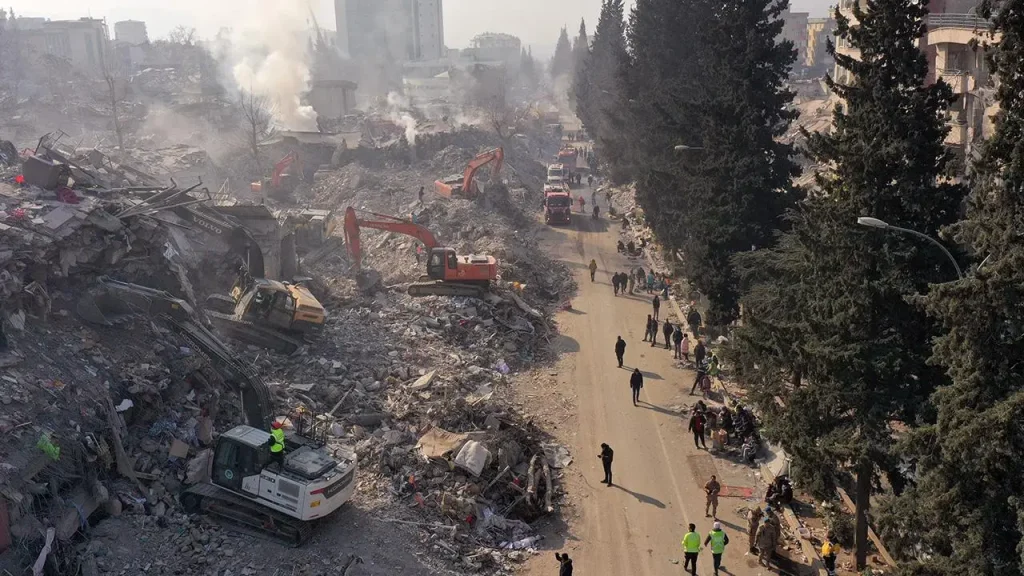
Three years have passed since the earthquakes of February 6. In my devastated hometown of Hatay, I have found myself caught between my identities as both an earthquake survivor and an urban planner. There are certain identities one does not choose; they are lived through, fallen into, and learned by force. Being an earthquake survivor is one such identity. Becoming an urban planner, on the other hand, is the result of a long academic journey, intellectual labor, and ethical responsibility. After February 6, 2023, these two identities became inseparably intertwined in my life. I am no longer merely an urban planner who thinks about disasters; I am an urban planner who has remained within the disaster itself—who has breathed the dust of the rubble, tried to learn how to live with loss, and who, after the earthquake, even lost the title deed to the home whose mortgage she is still paying.
From the outside, this dual condition may appear to provide a powerful perspective: “She both lives it and works on it.” Yet from within, it is a constant state of mental and emotional tension. Being trapped between academic knowledge and lived trauma sometimes makes it difficult even to form a sentence. For years I have taught, contemplated, and debated concepts such as “resilience,” “disaster-sensitive planning,” “risk reduction,” and “spatial justice” within the planning literature. But when I walk through the streets of Hatay, most of these concepts are no longer abstract; they have transformed into tangible manifestations of pain, loss, and emptiness.
Before the earthquake, urban planning was largely an analytical discipline for me: data, maps, planning decisions, regulations, strategies… Of course, I was aware of its social dimension; for this reason, through my civil society identity, there were many issues on which I tried to produce solutions in the field. Yet becoming a direct subject of the disaster transforms knowledge itself. A building is no longer merely part of the building stock; it is a place where a life has frozen in time. A neighborhood is no longer simply an urban fabric; it is a field of memory where layers of recollections, relationships, and losses accumulate one upon another.
After the earthquake, my relationship with the city changed fundamentally. The concept of “place attachment,” which the discipline of planning teaches us, is no longer an academic term for me; it is a daily reality. When I pass through Uzun Çarşı, when I look at the Asi River, when I walk across the university campus, every corner carries both a data point and a fragment of personal memory. This condition also transforms academic production. In every sentence I write, in every analysis I make, the same question circulates in my mind: “Am I saying this as someone who has truly lived it, or is it merely a professional reflex?”
Being an earthquake survivor has made the ethical responsibility I carry as an urban planner even heavier. Because planning is no longer merely a technical matter for me; it is a matter of conscience. Every decision taken by both the central government and local authorities regarding the future of the city after the earthquake is not simply a subject of academic criticism or appreciation—it is something that directly touches my own life. For this reason, remaining silent has become more difficult, while speaking has become more costly. As a scholar, I am expected to maintain distance; yet as an earthquake survivor, that distance is often impossible.
At times, the opposite kind of guilt emerges: “I am alive; I can work; I can write.” Even this sentence carries a heavy burden in itself. Because while there are people around me whose lives have been completely overturned, continuing academic production sometimes feels meaningless. But then I realize something: perhaps it is precisely for this reason that I must continue to produce. Because I owe a debt to the city I live in, to those we have lost, and to those who remain. Planning knowledge finds its real meaning only when it merges with lived experience.
Being both an earthquake survivor and an urban planner has taught me this: a city is not merely composed of buildings, roads, and planning notes. A city is a living organism in which pain, solidarity, silence, resilience, and the will to rebuild are intertwined. And the duty of the urban planner is to try to understand this organism not only technically but also humanely. Today, in my classes, I no longer teach only theory; I also share experience, witnessing, and vulnerability. When I tell my students that “urban planning is not merely a profession but a matter of conscience,” I know how true this is because I have lived it myself.
Perhaps the most difficult aspect of carrying these two identities is walking the thin line between hope and realism. As an urban planner, I am obliged to produce scenarios for the future; yet as an earthquake survivor, I know how fragile that future can be. Despite all these difficulties, however, I believe this: if a city is to be rebuilt, those who should have the greatest voice in how it is done are the people who have actually lived in that city. For this reason, my voice is both a professional opinion and a personal testimony.
Being both an earthquake survivor and an urban planner is not easy. Yet perhaps in a city like Hatay, the coexistence of these two identities is a necessity. Because the recovery of this city will be possible not only through buildings, but through memory, justice, ethics, and a sense of belonging. And despite all my vulnerability, I will continue to remain a part of this process.
This experience has also taught me another truth: post-disaster reconstruction processes are often treated merely as a matter of physical construction. Yet the real issue is the reconstruction of life itself. The days people have spent in container settlements have shown me how temporary solutions can gradually become permanent. I witnessed how spaces described as “temporary” slowly turn into people’s only reality. Children inventing games in the narrow spaces between containers, elderly people sinking into long silences on plastic chairs, young people carrying the empty gaze of those who have lost their sense of belonging… None of these ever appear between the lines of a planning report. Yet the city we speak of is composed precisely of these invisible experiences.
The principle of participation, which I have defended for years as an urban planner, became one of the most neglected aspects of the post-earthquake process. Decisions taken without asking people what they want, where they wish to live, or what kind of neighborhood they imagine have deepened not only spatial but also psychological ruptures. Yet a city cannot be rebuilt without the consent and participation of its inhabitants. For this reason, I now see participation not merely as a method but as an ethical necessity. Being an earthquake survivor has shown me that this necessity is not theoretical, but a matter of life itself.
This process has also led me to develop a more critical perspective on the profession of urban planning. The centralized structure of the planning system, decision-making mechanisms that fail to listen to local knowledge, the tendency for technical expertise to overshadow the human dimension… All of these became far more visible in the context of post-earthquake Hatay. My commitment to my profession as an urban planner has not diminished; on the contrary, it has grown stronger. Yet this commitment is no longer a blind sense of belonging; it has transformed into a form of responsibility that questions and seeks to transform.
Sometimes I wonder: if I had not experienced this earthquake, would my understanding of urban planning have deepened in this way? Probably not. Because some forms of knowledge can only be learned through experience. The knowledge of trauma is not acquired from books, but from life. And this knowledge both makes a person more vulnerable and turns them into a more sensitive professional. Now, when I look at a planning sheet, I no longer see only the distribution of functions; I imagine the everyday lives, fears, and hopes of the people who will live there.
Perhaps what has changed most for me in this process is my understanding of the concept of “expertise.” Previously, expertise meant mastering technical knowledge, knowing the regulations, and being able to conduct analyses. Now, expertise also means being able to listen, to understand, to remain silent, and sometimes simply to bear witness. The earthquake taught me that planning is not only about producing solutions but also about accompanying pain. For this reason, I now see myself not only as an urban planner but also as a person who carries the wound of the city she lives in and who tries to speak so that this wound may heal.
This new form of expertise has made me a slower but more attentive person. I now believe less in rapid solutions, grand claims, and dazzling projects, and more in small but meaningful interventions. Preserving the memory of a neighborhood, ensuring that a person’s voice is truly heard, contributing to the possibility that a child can once again play safely in the street… For me, these have become the most genuine measures of professional success. Because I have learned that cities heal not only through grand plans but through relationships of trust built at a human scale. And I see being part of that healing as one of the heaviest, yet most meaningful responsibilities one can carry.
And in closing: if I can still hold on to hope while walking through a heavily wounded city, if I still feel the need to speak, if I still believe in the transformative power of planning… perhaps this is the most honest form of loyalty I can show to those we have lost. I will remain here, continue to bear witness, and accompany the story of this city rising again with the sentences that fall to my share.