
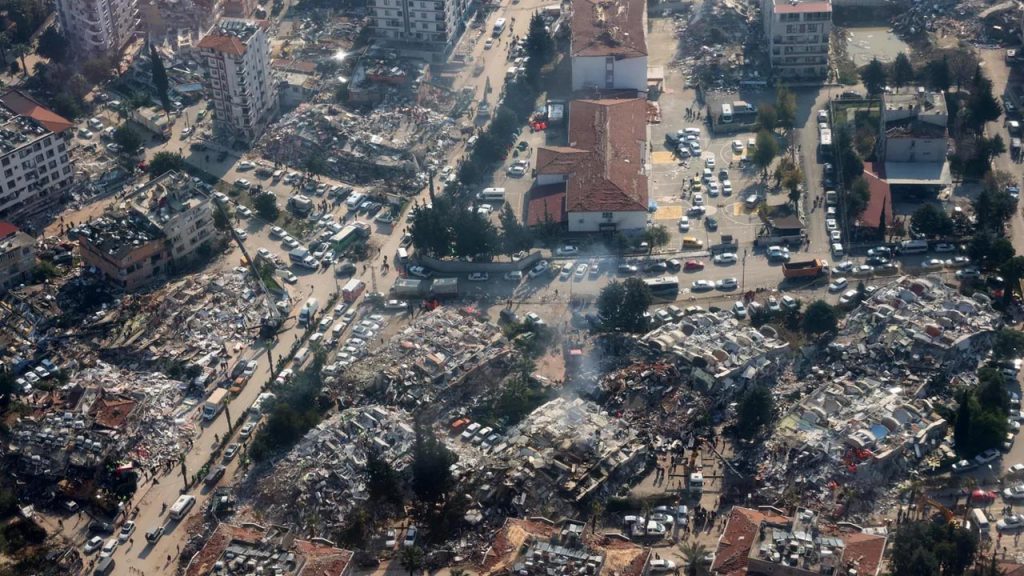
Three years have passed since the February 6 earthquake. This great catastrophe laid bare not only the painful consequences of physical destruction but also a moral, political, and social threshold. Immediately after the earthquake, the expression “the disaster of the century” was rapidly circulated. This characterization was widely adopted in order to convey the magnitude of the catastrophe and soon turned into an almost unquestionable definition. Yet this phrase proved insufficient to fully capture the true dimension of the disaster. For our issue here is not merely the shaking of the earth. It is the collapse of responsibilities that, as Turkish society, we have long kept in suspension.
In the aftermath of the earthquake, in every forum where discussion was possible—especially on social media—the call to “hold those responsible to account” grew louder. We were going to demand accountability from those responsible. In doing so, we would satisfy our consciences and begin to heal our wounds. At first glance, this call seemed to serve a function that sustained the sense of justice, soothed the conscience, and even gave people the feeling that they were doing something. Yet precisely for that reason, this call contains a troubling aspect that deserves careful reflection. For the very idea of calling someone to account implies, first and foremost, that something has already happened, reached its conclusion, and become irreversible. This means that holding someone to account is inevitably a practice that comes into play after the events have occurred.
However, our fundamental issue is our capacity to prevent disasters before they take place. Calculating—weighing and reckoning carefully, in other words thinking through and planning things meticulously—is far more important than calling someone to account. The elders expressed this succinctly with the saying “Ba‘de harâbü’l-Basra”: after Basra has been ruined. Once Basra has been destroyed, once the damage is already done, whom would demanding accountability benefit, and how?
Reflecting on calling others to account is one of the most fundamental lessons the earthquake has left us. For if we demand accountability after a great destruction but fail to maintain the same attitude of questioning and scrutiny before such destruction occurs, this indicates a structural moral problem. That problem lies hidden in the underdevelopment of our sense of responsibility. Calling someone to account is often a belated attempt to compensate for a responsibility that has already been missed. At best, it may prevent a similar kind of destruction from happening again—yet even that is only possible under the assumption of a flawless system of justice and oversight. In this sense, calling someone to account is not a powerful act. On the contrary, it carries within it a certain deficiency. The attempt to intervene after the fact—once everything has already happened—makes the inadequacy of the “calling to account” posture unmistakably visible. The stronger posture is to make calculation and accountability a state of constant vigilance. Only then will natural disasters be discussed and debated without the need for expressions such as “the disaster of the century.”
The immense destruction caused by the earthquake did not merely expose problems related to building safety or crisis management; it also revealed the stage at which our moral sensitivities come into play. If sensitivity toward an issue emerges only after that issue has already materialized, the sincerity of such sensitivity inevitably becomes questionable. Genuine moral sensitivity manifests itself not after events have occurred, but before they take place or while the process is still unfolding. From this perspective, the earthquake tragically demonstrated how late our moral reflexes tend to operate in many matters.
This lateness is not unique to institutions or specific actors. On the contrary, the issue of responsibility extends broadly enough to encompass all members of society. To the extent that we direct responsibility solely toward certain individuals or institutions, we effectively push moral obligation outside the sphere of our own daily lives and practices. For this reason, the idea of “holding those responsible to account” acquires meaning only when it is considered alongside our capacity to question our own responsibilities and our collective moral framework.
The fundamental truth the earthquake reminded us of is this: irresponsible governments, unregulated structures, and chains of mutually reinforcing negligence do not arise spontaneously or in a vacuum. They are gradually produced within social relations and patterns of acceptance. If certain individuals have been able for years to systematically carry out activities that put the lives of others at risk, and have not been held accountable for them, this cannot be explained merely by their personal immorality; it must also be explained by the existence of an environment that enables such immorality.
At this point, the issue of responsibility should not be reduced to an abstract feeling of guilt. Rather, responsibility must be conceived as a concrete ethical practice that permeates the entirety of society and everyday life. This ethical practice takes shape around the question of whether we are accountable in the work we perform, the professions we practice, and the services we provide. At the same time, it requires us to ask whether we are inclined to remind those responsible of their moral obligations even in small, ordinary, and low-visibility problems. For very often our moral reflexes are activated only when destruction becomes large, visible, and socially resonant.
Under such circumstances, it means that—whether knowingly or unknowingly—we ourselves contribute to the proliferation of the social and moral problems we confront. There is no escaping this responsibility. The fact that the earthquake did not occur in Istanbul, İzmir, or other major cities does not invalidate these questions; on the contrary, it expands the boundaries of responsibility not only spatially but also temporally.
The crises we may face in the future do not necessarily have to emerge at the same scale or in the same form. Smaller, quieter, and more localized forms of destruction are also possible. For this reason, the essential issue is not the reactions shown after disasters occur, but whether we possess moral attentiveness and a continuous practice of questioning in the face of such possibilities before they unfold. Otherwise, it will be inevitable that every new devastation will once again be described as “the disaster of the century.”
In this context, our vision for protecting ourselves from the destructive effects of earthquakes cannot be confined solely to new buildings, stricter regulations, or harsher penalties. A future without disasters also requires imagining a social order in which responsibility becomes part of everyday life and spreads across every member of society. The most precious flower of this vision is a civic consciousness manifested in questioning and oversight.
The essential goal is a social order in which calculation is not an exceptional reflex and accountability has become an ordinary and indispensable norm. Our collective duty is to create a moral climate in which people ask themselves—not only after disasters, but every day, in every task, and in every relationship—the question: “Can I give an account of what I am doing?”
And such a social order cannot be built on the expectation of salvation from those in power. For what is ethical is not the constant delegation of responsibility upward, but its horizontal diffusion throughout the entirety of social relations. In this sense, the earthquake stands as a stern warning that responsibility is a matter that cannot be postponed, transferred, or shifted onto someone else.
In conclusion, February 6, 2023, is a date of immense loss and destruction for our country. At the same time, it marks a threshold at which a moral reckoning has become unavoidable. If this reckoning remains limited to demanding an account of the past, it will remain incomplete. The real issue is not calling others to account, but making calculation and accountability into a societal principle.
In a world where the understanding of responsibility has been shelved, the posture of calculating and being accountable should be regarded as a moral emergency brake. Only in this way can the words spoken after the lives that were lost be transformed into the foundation of a genuine future.